All cabinetry is built to order. Some previous examples of our work with indicitive prices and lead times are shown below. Prices current for April-June 2026, you will be quoted a price as part of your order.
Work is generally performed with hand tools, where machine tools are used for things like bulk stock preparation, all surfaces are finished with hand operations.
Lightweight six-board chest of Mary Rose Type 2.1 construction, suitable for use from the 13th to 17th centuries. Made from select grade radiata pine, with nailed construction using hand-headed nails. Nail placement has been informed by Type 2.1 chest 81A1302. Finished with paint tinted to match the iron oxide-rich limewash that had to be applied annually to the originals. The butterfly hinges have been taken from a Type 2.2 chest, 80A1217, and have been heat blued to protect from rusting.
I’ve made this chest long enough to fit 32” arrows; it will be strong enough for most re-enactment equipment but probably not long weapons and armour. External dimensions 860mm (l) x 235mm (w) x 255mm (h).
Pine, glued and nailed assembly, nailed base, lid cleats. Single colour paint. A$250; hinged lid A$50; lock and key, A$125. Lead time 4 weeks.
Reference: Gardiner, J. [Editor]. (2003). Before the Mast: Life and Death Aboard the Mary Rose. United Kingdom, Portsmouth: Mary Rose Trust.
Hildred, A. [Editor]. (2011). Weapons of Warre – The Armament of the Mary Rose. United Kingdom, Portsmouth: Mary Rose Trust.
.jpg)
Simple nailed six-board box with loose lid. Lid kept aligned with cleats, I also have cleats inside to align spacers to keep my arrows separated. Morris board carved in the lid. Pine, red iron oxide pigment paint inside and out.
Pine, glued and nailed assembly, nailed base, lid cleats. Single colour paint. A$250, internal fittings, carving extra. Lead time 4 weeks.
Reference: Gardiner, J. [Editor]. (2003). Before the Mast: Life and Death Aboard the Mary Rose. United Kingdom, Portsmouth: Mary Rose Trust.
Lightweight six-board Mary Rose arrow chest, suitable for use from the 13th to 17th centuries. The originals were long enough to hold sheaves of arrows facing point-to-point. The lids were nailed shut and pried off when the contents were needed. I've gone with the conceit that someone recovered one and adapted it for reuse by attaching a pair of butterfly hinges. I use this one as a tool chest for longer tools.
Made from select grade radiata pine, with nailed construction using hand-headed nails. Finished with paint tinted to match the iron oxide-rich limewash that had to be applied annually to the originals. The butterfly hinges have been taken from a Type 2.2 chest, 80A1217, and have been heat blued to protect from rusting.
I’ve made this chest long enough to fit 32” arrows; it will be strong enough for most re-enactment equipment but probably not long weapons and armour. External dimensions ....
Pine, glued and nailed assembly, nailed base, lid cleats. Single colour paint. A$350; hinged lid A$50; lock and key, A$125. Lead time 4 weeks.
Reference: Gardiner, J. [Editor]. (2003). Before the Mast: Life and Death Aboard the Mary Rose. United Kingdom, Portsmouth: Mary Rose Trust.
Hildred, A. [Editor]. (2011). Weapons of Warre – The Armament of the Mary Rose. United Kingdom, Portsmouth: Mary Rose Trust.
.jpg)
This one is my interpretation of an original box by the Savell family of Braintree Masssachusetts, ca 1660. Oak sides, tulip poplar lid and base, Himalayan cedar till. The corners are glued with hide glue and pegged with wooden pins. The bottoms are nailed on with handmade iron nails. I didn't have time to make the lock that was on the original.
Boxes of this style were produced in England, Cornwall and the colonies from the middle of the the 17th century onwards. The size was often dictated by the available timber sizes, but typically they were 175-200mm high, 560-600mm wide, and about 355mm deep front to back. Those from the American colonies were from riven wood, almost invariably featured tills and often had lids and bases from white pine rather than oak boards. English boxes tended to be entirely from pitsawn oak. Carving styles were highly regional and were maintained across generations in particular families, designs in England typically appeared 50 years earlier than in the Virginian colony.
In oak, carved on the front face only, pintel or iron gimnal hinges, glued and pegged assembly, nailled base, lid edge detail. Oak lid and base will be made from edge jointed boards. Option for single board antique kauri pine lid and base instead of oak. A$800; one or more till(s)A$50 each; painting in two colours A$50; lock and key A$125. Lead time 8 weeks.
References: Follansbee, P. (2019). Joiner's Work. United States, Kentucky: Lost Art Press LLC.
Follansbee, P. (2022, December 26). the Savell/Braintree boxes. Peter Follansbee: Joiners Notes. pfollansbee.wordpress.com/2022/12/26/the-savell-braintree-boxes/
.jpg)
Small wainscot/candle box in oak with oak pegged construction throughout. Wainscot is a thinner grade of oak usually used for panelled wall covering, but was also used for small cabinetry. The strapwork style is inspired by the original Exeter strapwork from Devon. Tudor Roses from Elizabeth I's coffin (1603), white marigolds from Robert Mindum's hornwork, particularly the Hinson shoehorn from 1600. Lettering style and proportions from Durer's Of the Just Shaping of Letters (1535). This example is 250mm wide by 100mm deep.
All oak, carved on the front face only, pintel or iron gimnal hinges, glued and pegged assembly, nailled base, lid edge detail. A$500; carving on ends and lid A$100; painting in two colours A$50; lock and key A$125. Lead time 8 weeks.
References: Follansbee, P. (2019). Joiner's Work. United States, Kentucky: Lost Art Press LLC.
Chinnery, V. (1979). Oak Furniture – The British Tradition. United Kingdon, Suffolk, Woodbridge. ACC Art Books.
Roe, A. (1920). History of Oak Furniture. United Kingdom, London: The Connoisseur.
Robinson, W. (2018, December 23). Another box. The Reverend's Musings. leatherworkingreverendsmusings.wordpress.com/2018/12/23/another-box/
.jpg)
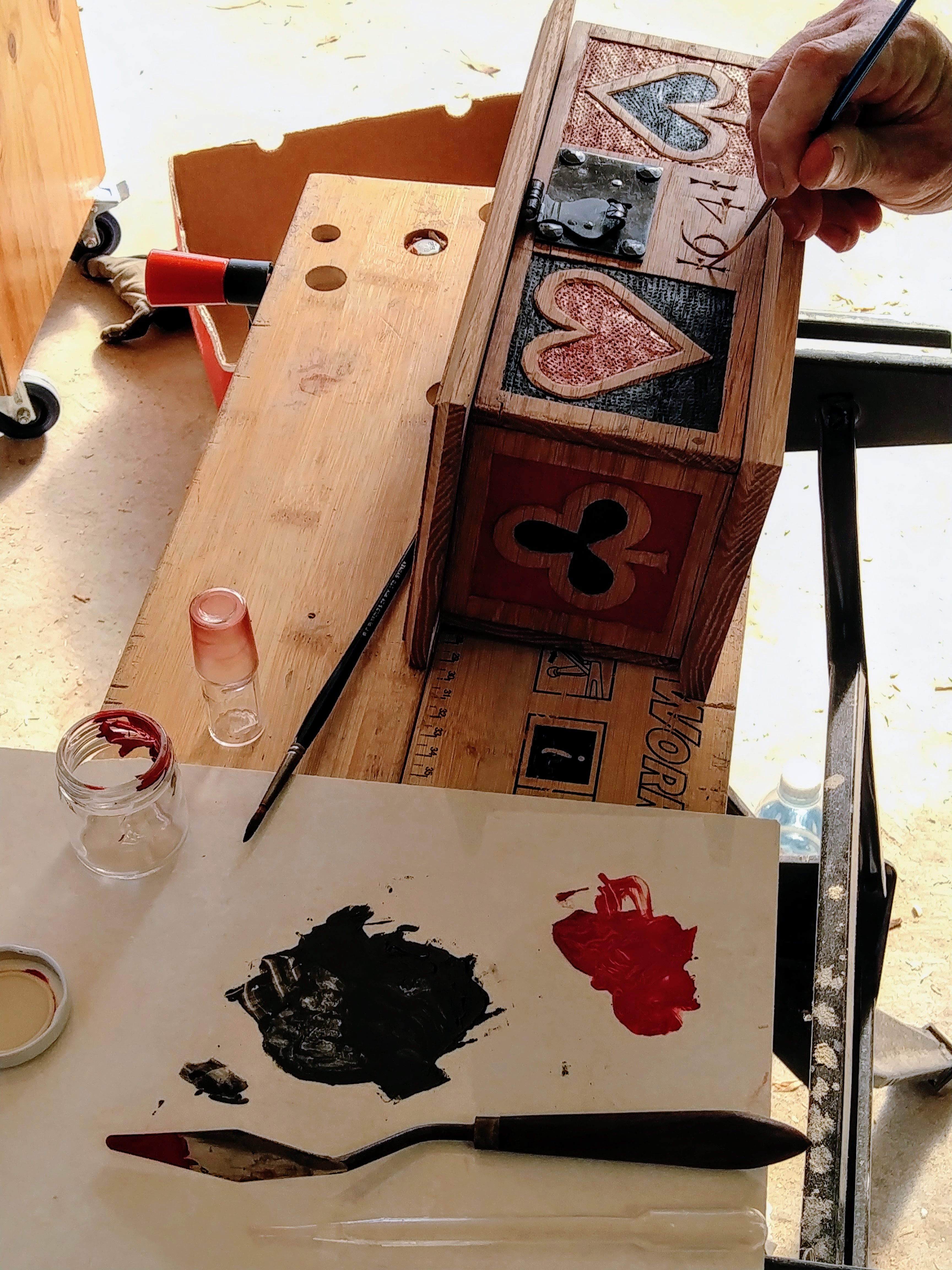
Conjectural small wainscot box in oak. I made the box, lock, hinges, paint and reprofiled the nails. The decoration is based on a mid 17th c pike armour in the Royal Armouries London and another similar in Warwick Castle, red paint is a modern vermillion pigment without the mercury and the black is a carbon black, both ground in linseed oil.
All oak, carved on the front face only, pintel or iron gimnal hinges, glued and pegged assembly, nailled base, lid edge detail. A$500; carving on ends and lid A$100; painting in two colours A$50; lock and key A$125. Lead time 8 weeks.
References: Follansbee, P. (2019). Joiner's Work. United States, Kentucky: Lost Art Press LLC.
Chinnery, V. (1979). Oak Furniture – The British Tradition. United Kingdon, Suffolk, Woodbridge. ACC Art Books.
Robinson, W. (2022, April 22). Another wainscot box. The Reverend's Musings. leatherworkingreverendsmusings.wordpress.com/2022/04/22/another-wainscot-box/

Fourteenth century salt box based on an original in the Budapest Historical Museum. It was found in the cellar well in a house (Disz Square No. 10) on Buda Castle Hill. The original was undecorated, the compass flower on the front is my addition (horror vacui is a dreadful thing). I use this as a chalk box in the workshop.
Academics now abed in England will be excitedly clamouring to explain the apotropaic mark on the front being a defence against witches. Which is silly, all the witches I know are welcome to use the chalk if they need it. It also comes in handy if I need a 60°, 120°, 180° or 240° reference.
European oak, pegged construction using hide glue, pintle hinges on the lid. 120mm high and deep, 100mm wide.
We'd be looking at about A$100 for a similar example in oak, less in cheaper timbers and no decoration. Lead time would be about 3 weeks.
Construction of this salt is covered in the 14th century volume of our 'Historical Replica Constructions in Wood and Metal' series.
Reference: Wyley, S. et al. (2023, December). Historical Replica Construction: 14th Century: Volume 1. Australia, Victoria: Intertype.
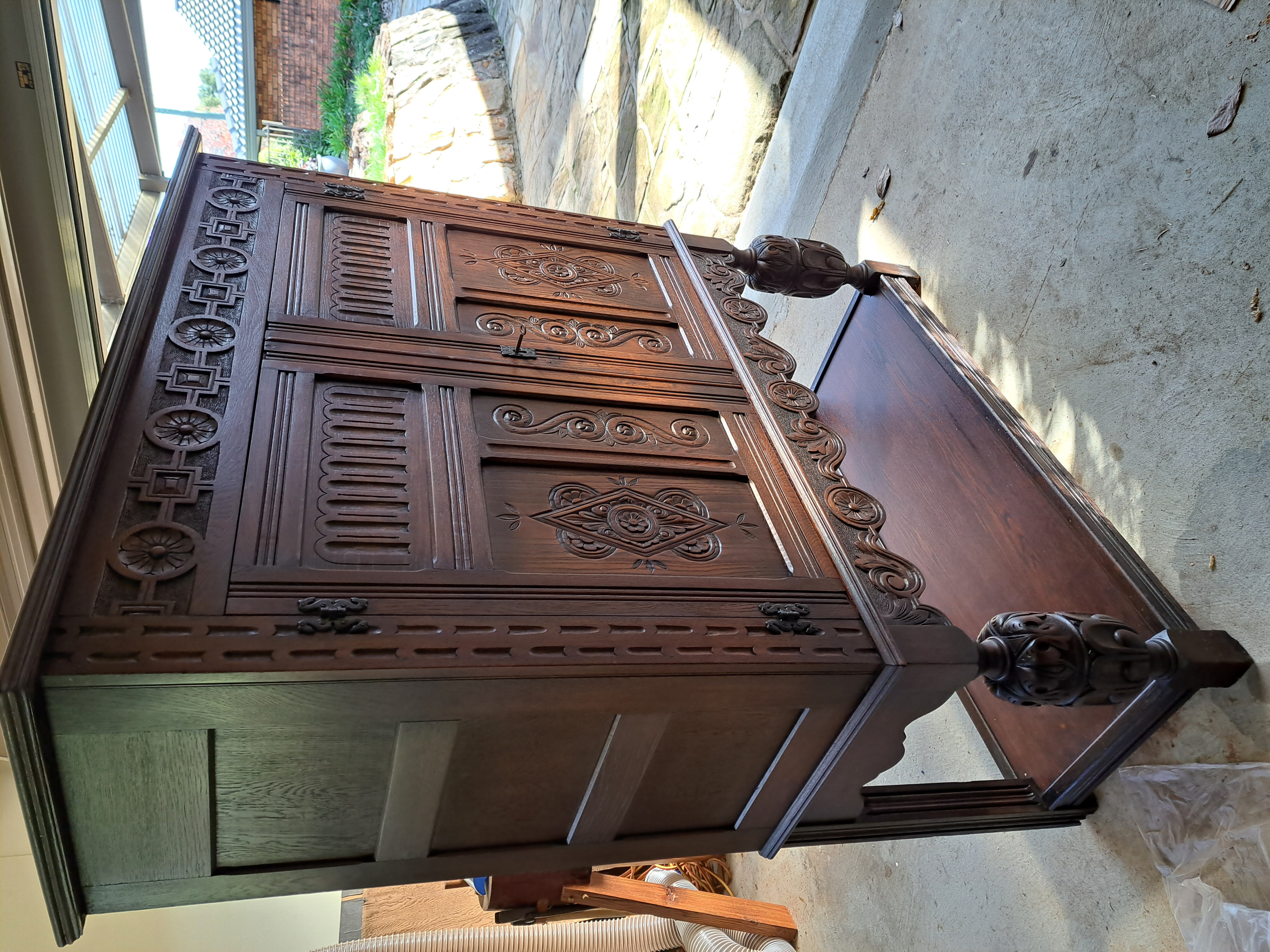
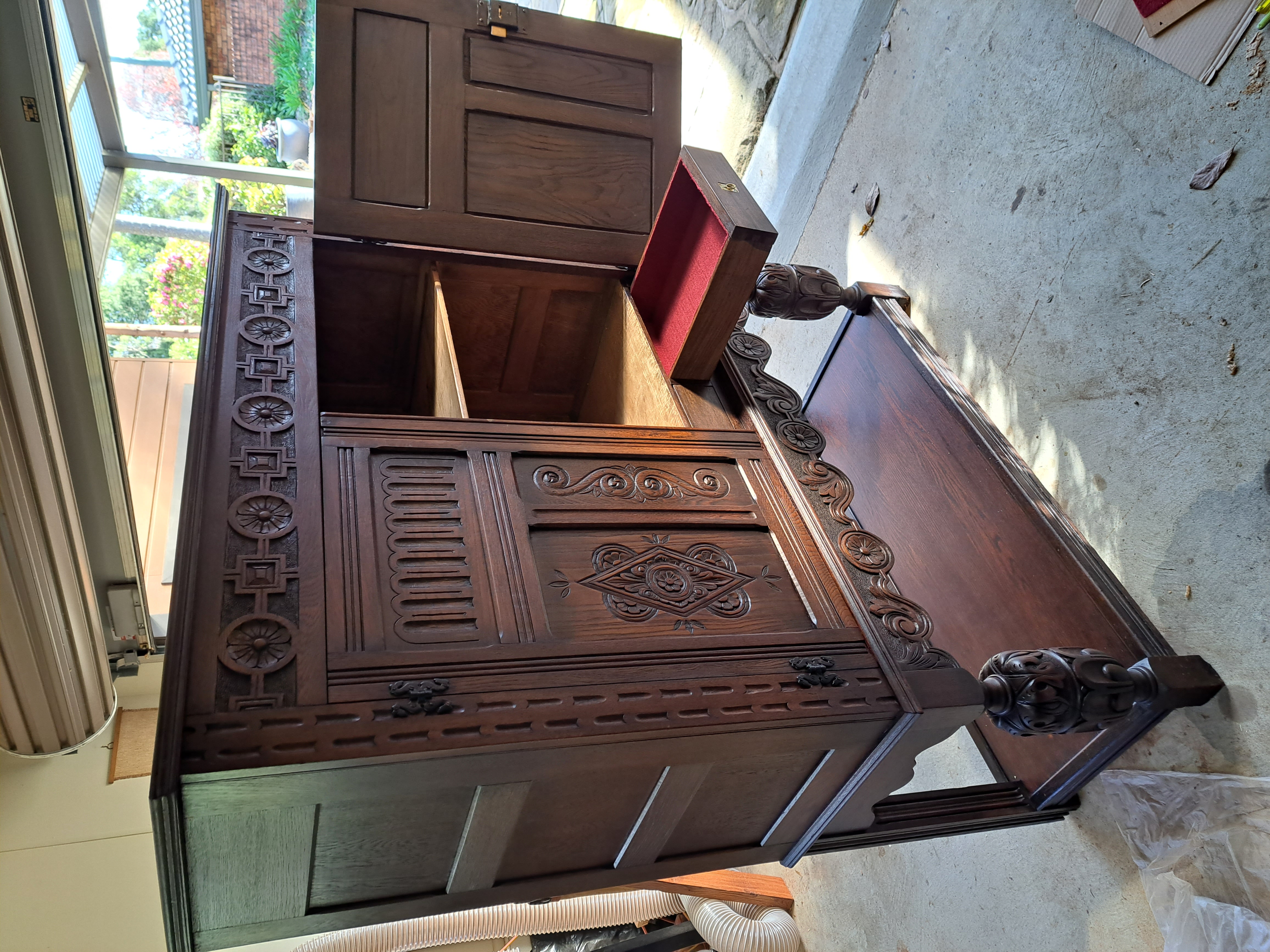
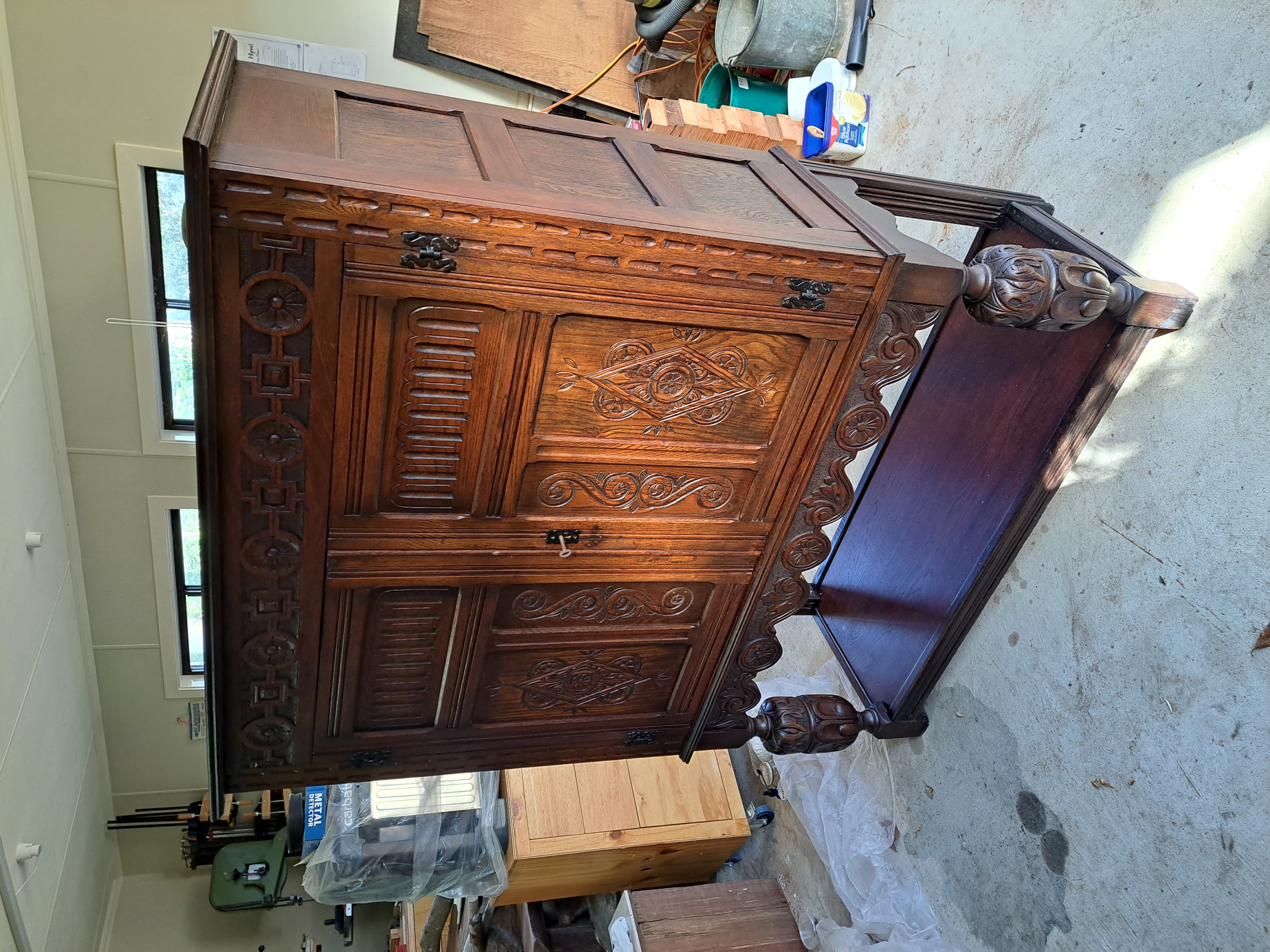
This one was a restoration rather than new build. C.1920s cabinet, made in England, exported to Australia after spending 1940-1970 in South Africa. When I bought it, it had been outside for a few years and was exhibiting water damage. Cleaned inside and out. Replaced failed ⅛" oak ply on top and ¼" shelf with 7mm red oak ply, and delaminating ⅛" oak ply on the side with 3mm red oak ply. Remade all joints using hide glue, replaced missing parts with oak, pine or walnut as appropriate. Black lead paint on metalwork removed and replaced with water-based metal paint following the original foundry's advice. Made new cornice to suit thicker top in mountain ash. Planed drawer sides to ease binding.
Renovated lock and replaced levers with new brass. Replaced missing drawer hardware pieces – the drawer pulls aren't original but are part of the history of the piece because they date from the last restoration in the 1970s.
Colour matched all new wood with van Dyke crystals, then another coat overall to freshen up the old colour. Filled nail holes with home made linseed oil putty coloured with burnt umber. Replaced drawer lining with wool/viscose baize and wheat starch paste. Sealed with shellac and polished with beeswax/turpentine/linseed polish.
This one's not for sale. If I could be convinced to do another, I'd be looking for at least A$1,000 (not including the purchase price), 3-6 months work time plus many weeks' lead time to clear the orderbook and workshop.


.jpg)
.jpg)
.jpg)
.jpg)
.jpg)